
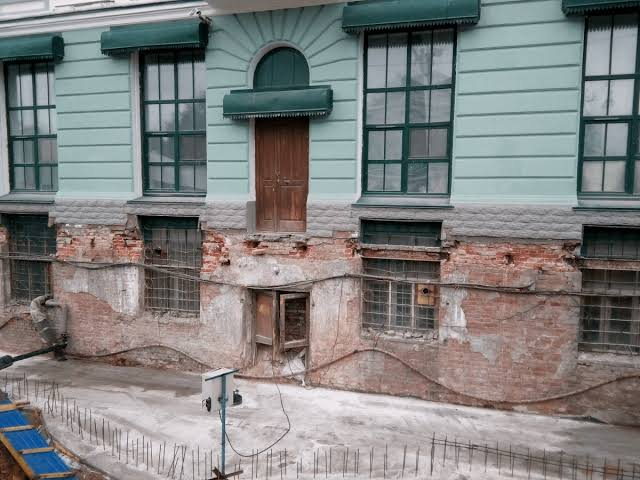
Buried windows exposed during downtown renovation. Source: Reddit
Walk through almost any historic 19th-century downtown core in North America, Europe, or Australia, and you will notice an architectural oddity: massive brick and stone buildings with full windows, ornate doors, and decorative moldings half-buried beneath street level. In city after city, ground-level sidewalks abruptly cut across arched masonry frames that were clearly designed for open air and natural light.
While mainstream civil engineering archives explain these features through urban regrading and sewer modernization programs, an explosive alternative theory known as the “Mud Flood” has captivated millions across digital history forums.
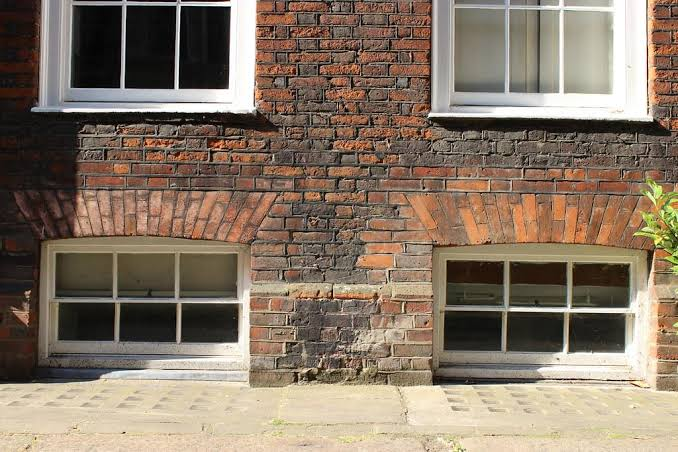
Half-buried 19th-century windows at street level. Source: Reddit
The theory claims that a cataclysmic, undocumented global disaster buried the ground levels of an advanced worldwide civilization sometime in the late 18th or 19th century, forcing survivors to rebuild civilization atop forgotten foundations.
Online history researchers point to thousands of unearthed basement windows, massive subterranean archways, and abrupt stylistic uniformities across global architecture as physical evidence of an erased past.
The Anatomy of the Buried Floor Debate
Proponents of the Mud Flood hypothesis point to consistent visual anomalies found in 19th-century municipal buildings:
- Deeply submerged lower-level windows with elaborate brick lintels sitting several feet below paved sidewalk grades.
- Subterranean stairwells and arched exterior entryways that lead directly into solid packed earth and masonry walls.
- The sudden, rapid construction of colossal Greco-Roman civic structures in pioneer frontier towns with limited populations and minimal heavy machinery.
To alternative researchers, the idea that builders deliberately constructed elaborate, full-sized decorative windows directly against subterranean dirt walls defies common architectural logic.
What Mainstream Architecture and Civil Engineering Explain
Geologists, urban historians, and structural engineers offer a documented civil explanation for why historic building bases sit below modern streets.
During the mid-to-late 1800s, rapidly growing industrial cities faced massive public sanitation crises. To install subterranean sewer mains, water distribution grids, and transit networks, municipalities executed sweeping “street-raising” and urban regrading projects.

Historical street raising on Lake Street, Chicago. Source: Wikipedia
Cities like Chicago, Seattle, and Atlanta systematically raised their entire street levels by several feet, turning original ground floors into daylight basements and pedestrian vault corridors.
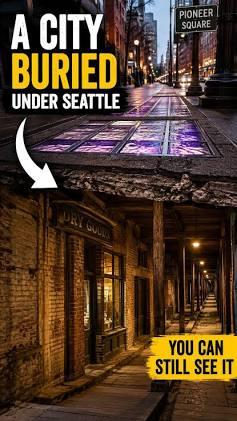
Subterranean storefronts beneath Seattle’s streets. Source: Facebook
Furthermore, 19th-century architects intentionally designed “English basements” and lightwells to illuminate lower service quarters with natural sunlight before electrical grids existed.
The Enduring Fascination With Hidden History
Despite standard municipal engineering records, the Mud Flood narrative continues to expand across digital platforms, driving a massive wave of independent architectural exploration.
Whether viewed through the lens of urban engineering history or alternative timeline mysteries, inspecting the subterranean levels of historic downtowns reveals how profoundly our modern streetscapes have shifted over the last two centuries.
[SOURCES & VERIFIED DOCUMENTATION FOR READERS]:
- Historic American Buildings Survey (HABS): 19th-Century Urban Regrading & Basement Lightwell Archives
- Association of Civil Engineers: Historical Municipal Street Raising Case Files (Chicago & Seattle)
- Architectural History Review: The English Basement & Subterranean Masonry Analysis
Have you ever spotted half-buried windows or sunken doorways on historic buildings in your city? Do you believe they are simple street regrades, or evidence of a forgotten historical event? Drop your city, state, or country below and let’s compare observations!