
Imagine living in a country where much of the drinking water comes from the sea. Israel has made that possible through large-scale desalination, wastewater recycling, and long-term water planning.
A Nas Daily feature highlighted Israel’s transformation into a country that obtains most of its drinking water from desalinated seawater. Scientific literature reports that desalination supplies approximately 75% to 80% of Israel’s drinking water.
Could the Philippines learn from this approach, especially in coastal communities that experience dry-season water shortages? The answer involves more than simply building a desalination machine. It requires an entire system for producing, treating, distributing, and managing water.
Watch: Nas Daily’s feature on Israel’s desalination system
This video introduces Israel’s use of seawater desalination and its role in the country’s water supply. If the embedded player is blocked by your browser or website settings, use the direct YouTube link below.
open the video on YouTube.
Important: Confirm that the video above is the exact Nas Daily feature you intend to publish. The video ID is retained from the previous draft and has not been independently verified here.
How does Israel turn seawater into drinking water?
Israel uses large desalination facilities to remove dissolved salts from seawater. Many use reverse osmosis, a process in which seawater is pushed at high pressure through specialized membranes. These membranes allow water to pass while retaining most dissolved salts.
The resulting water undergoes additional treatment and quality checks before it enters the drinking-water supply. Desalination does not simply turn untreated seawater directly into safe drinking water. Pretreatment, post-treatment, monitoring, and reliable distribution are also essential.
Inside the desalination process
- Seawater intake: Seawater enters the facility through an intake system, where screens remove debris and larger material.
- Pretreatment: Filters and other processes help protect the membranes from suspended particles and biological fouling.
- Reverse osmosis: High pressure pushes water through membranes that separate much of the salt from the water.
- Post-treatment: The product water is conditioned and checked against applicable drinking-water requirements.
- Distribution: Treated water is stored and delivered through pipelines into the water-supply network.
The process also produces concentrated brine containing the salts removed from the seawater. Facilities must manage this residual stream responsibly to reduce potential impacts on coastal ecosystems.
Inside a real Israeli desalination plant
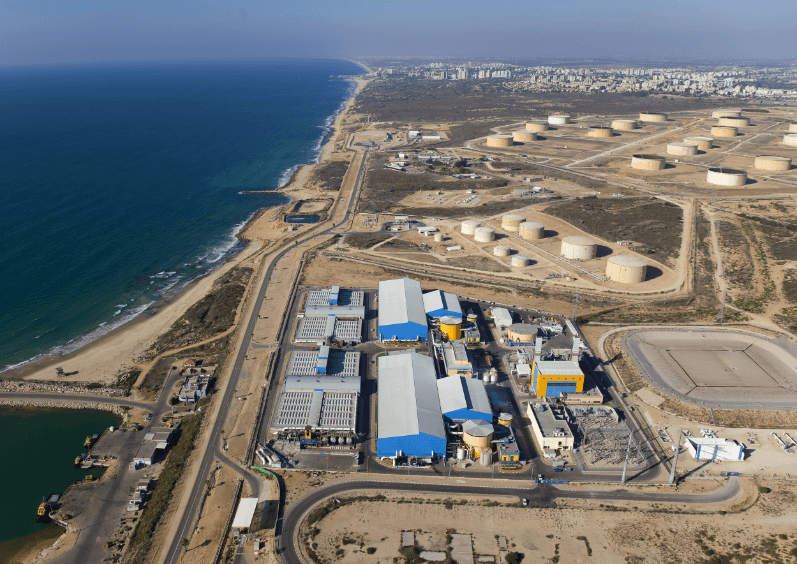
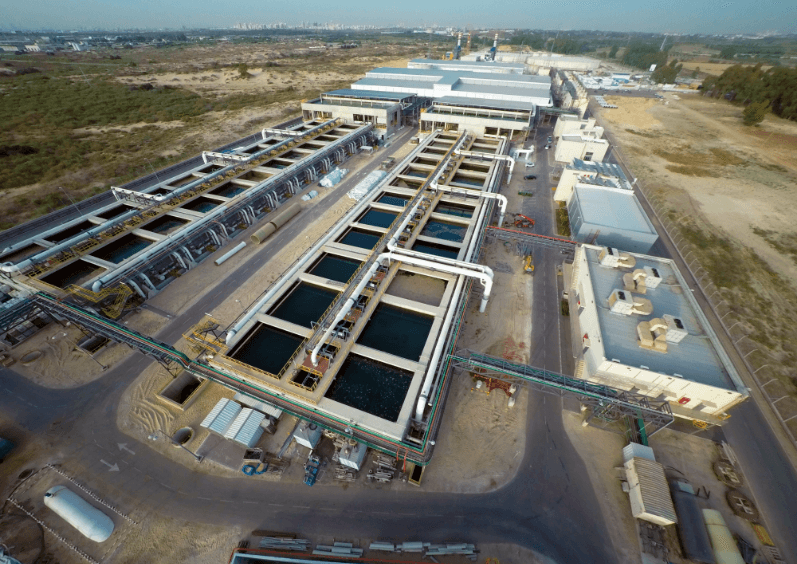
The Ashkelon plant is an example of the large infrastructure behind Israel’s water strategy. IDE Technologies identifies the facility as a seawater reverse-osmosis plant commissioned in 2005, with a reported capacity of approximately 396,000 cubic meters per day.
This scale is important. Israel’s desalination achievement was not created by a single small water station or by NGOs alone. It developed through national water planning, public authorities, major infrastructure investment, and industrial operators.
Watch: Inside the Ashkelon desalination plant
IDE Technologies has published a technical video about the Ashkelon plant. The embed below uses the video ID from the earlier draft. If it does not play, use IDE’s official video page, which is the more reliable source.
View the official IDE video page.
How did Israel reach the 80% figure?
Scientific literature reports that desalination supplies approximately 75% to 80% of Israel’s drinking water. The OECD has also reported that desalination plants supply more than 80% of Israel’s domestic urban water. These figures refer to particular categories of water use, not every drop used across the entire country.
The share can vary with demand, operating conditions, and the period being measured. It is therefore more accurate to say that desalination supplies roughly three-quarters to four-fifths of Israel’s drinking or domestic urban water than to claim that exactly 80% of all water used in the country comes from the sea.
Desalination is only one part of Israel’s water strategy
1. Large-scale desalination
Coastal facilities provide a substantial source of freshwater that is less dependent on rainfall. This helps reduce dependence on natural freshwater sources during dry periods.
2. Wastewater recycling
Treated wastewater is an important source for agriculture and other suitable uses. Reusing water can reduce competition between agricultural demand and drinking-water needs.
3. Conservation and planning
Water security also depends on efficient use, infrastructure maintenance, monitoring, and planning for droughts and other disruptions. Even a country with extensive desalination capacity must manage demand and prepare for operational problems.
Is desalination cheap and environmentally friendly?
Desalination can provide a dependable source of water, but it is not cost-free. Building a large plant requires substantial capital investment, while operating it requires electricity, specialized equipment, trained personnel, and continuing maintenance.
There are also environmental considerations. Seawater intake can affect marine organisms, and poorly managed brine discharge can affect coastal ecosystems. Plant design, energy efficiency, intake systems, and responsible brine management are important parts of a sustainable project.
For these reasons, desalination should be evaluated alongside conservation, leakage reduction, wastewater reuse, watershed protection, and other options. The best combination depends on local water needs, energy prices, geography, and environmental conditions.
Could the Philippines adopt Israel’s approach?
The Philippines has extensive coastlines, and some island communities face freshwater constraints because of limited groundwater, seasonal rainfall, saltwater intrusion, or expensive water transport. Desalination could help some of these communities, particularly where conventional sources cannot reliably meet demand.
However, Israel’s experience should not be copied without considering local conditions. A large desalination plant may suit a major urban water network, while a remote island may need a smaller system designed around local demand and available technical support.
Before investing, local governments and water providers should assess:
- Water demand: How much drinking water is required daily, and how much supply is missing?
- Total cost: Can the community afford construction, electricity, maintenance, and eventual equipment replacement?
- Energy reliability: Can the facility operate consistently, including during emergencies?
- Environmental safeguards: How will seawater intake and concentrated brine be managed?
- Distribution: Can treated water reach the households that need it at an affordable price?
- Alternative solutions: Would repairing leaks, protecting watersheds, improving storage, or reusing wastewater provide better value?
What Cebu can learn from Israel
Cebu’s desalination initiatives show why coastal water sources are receiving attention. But the lesson from Israel is bigger than building a plant: water security requires dependable production, effective distribution, proper financing, environmental safeguards, and a combination of water sources.
Desalination can add supply, while wastewater treatment and reuse can reduce demand for freshwater for suitable applications. Conservation and infrastructure improvements can help ensure that available water is not wasted before it reaches consumers.
For Cebu and other Philippine communities, the practical question is not simply whether seawater can be made drinkable. It is whether a project can deliver safe water reliably and affordably over the long term.
The bottom line
Israel demonstrates that desalination can become a major component of a national drinking-water system. Scientific literature supports the estimate that it supplies roughly 75% to 80% of the country’s drinking water, while other reports measure the contribution to domestic urban water differently.
But the achievement was built through coordinated infrastructure and water management, not simply by installing a machine. For the Philippines, desalination may be valuable in the right locations, provided costs, energy requirements, environmental effects, and distribution needs are carefully considered.
Sources and further reading
- Nas Daily video link used in this draft — verify the exact video before publishing
- Proceedings of the National Academy of Sciences: Research on desalination and water reuse
- OECD: Israel’s water management and desalination system
- Israel Ministry of Environmental Protection: Desalination facilities and environmental policy
- IDE Technologies: Sorek desalination plant
- IDE Technologies: Ashkelon desalination plant
- IDE Technologies: Official Ashkelon plant video page
- University of Texas Water Resources Podcast: Seawater desalination and wastewater reuse in Israel