

For generations, the baseline covenant between everyday consumers and major retail financial institutions was built on an incredibly simple concept: structural stability. Depositors placed their hard-earned income into checking and savings accounts under the absolute assumption that those funds would be guarded by robust, human-led security frameworks. In exchange, banks utilized standard interest rate spreads to generate profit, keeping consumer administrative fees minimal and predictable.
But as the official July 8, 2026 World Economic Outlook registry from the International Monetary Fund (IMF) rolls out, that foundational stability has completely fractured.
A hyper-aggressive technology arms race is forcing major commercial banks across the United States, United Kingdom, and Canada to quietly overhaul their financial layouts.
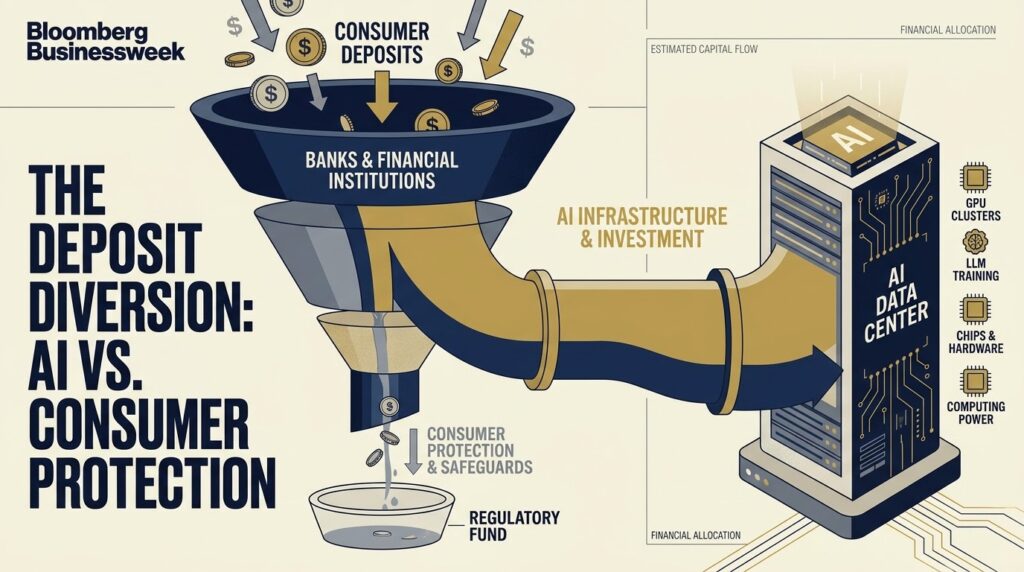
According to data compiled by industry analysts at FinTech Magazine, financial institutions are aggressively diverting billions of dollars away from traditional consumer protections to fund massive, unvetted enterprise AI pilots.

Inside the AI Divide
The underlying catalyst driving this systemic shift is what economists are calling the “AI Value Chain Divide.” According to the latest IMF Global Outlook Update, macro-economic growth has become highly uneven, with massive capital rewards funneling exclusively into sectors deeply integrated with automated technologies.
Terrified of becoming obsolete in an increasingly automated landscape, traditional retail banks are panicking to scale up their internal machine learning algorithms.
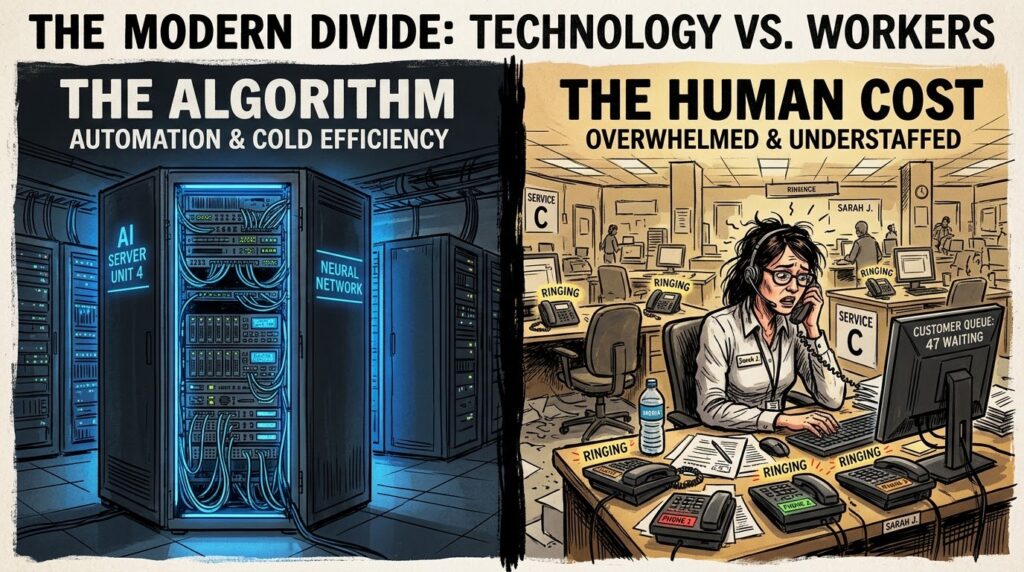
The operational bottleneck is that building and maintaining enterprise-scale artificial intelligence requires astronomical amounts of up-front infrastructure capital. To finance these high-cost corporate experiments, major institutions are quietly shifting their internal resource allocation—leaving standard consumer fraud prevention networks and manual customer support channels severely under-resourced while they chase automated data models.
Passing the Tech Bill to Depositors
Rather than absorbing these massive infrastructure outlays or allowing their corporate margins to take a hit, retail banking groups are passing the bill directly down to the everyday consumer. Across major North American financial platforms, depositors are documenting a sudden, silent wave of micro-fee adjustments:
- A sharp spike in non-transparent “account maintenance” and baseline administrative processing costs.
- Elevated account balance minimum thresholds designed to penalize lower-income checking accounts.
- A measurable slowdown in real-time fraud orchestration and resolution speeds, as automated bots replace human account security experts.

This strategic reallocation has triggered a massive consumer backlash. Financial registries indicate that while consumer reliance on digital banking apps is at an all-time high, baseline consumer satisfaction metrics have plummeted as users realize they are getting penalized with artificial markups engineered solely to fund a bank’s back-end software experiments.
Protecting Your Cash Capital
This hidden infrastructure shift is forcing financial advisors to issue an urgent warning to everyday savers: audit your bank statements immediately and fire your institutional loyalty. The smart money strategy for the remainder of the year is to rigorously cross-compare your current checking metrics against independent, credit unions or zero-fee fintech alternatives that refuse to pass their development costs down to the consumer.
Until major banking cartels re-align their tech infrastructure with actual consumer safety instead of corporate gimmicks, keeping your liquid savings insulated from stealth administrative updates is the most sophisticated personal finance move you can make.
[SOURCES & VERIFIED DOCUMENTATION FOR READERS]:
- International Monetary Fund (IMF) Registry: World Economic Outlook Update (July 2026)
- FinTech Magazine Institutional Performance Index: State of Enterprise AI Report
- Global Banking Consumer Asset Protection Registry: Corporate Micro-Fee Audit
Have you noticed sudden, weird micro-fees or automated customer service delays on your personal checking account this summer? Are you ready to move your money to a local credit union to avoid funding corporate tech experiments? Drop your city, state, or province below and let’s compare the data!For generations, the baseline covenant between everyday consumers and major retail financial institutions was built on an incredibly simple concept: structural stability. Depositors placed their hard-earned income into checking and savings accounts under the absolute assumption that those funds would be guarded by robust, human-led security frameworks. In exchange, banks utilized standard interest rate spreads to generate profit, keeping consumer administrative fees minimal and predictable.
But as the official July 8, 2026 World Economic Outlook registry from the International Monetary Fund (IMF) rolls out, that foundational stability has completely fractured.
A hyper-aggressive technology arms race is forcing major commercial banks across the United States, United Kingdom, and Canada to quietly overhaul their financial layouts.
According to data compiled by industry analysts at FinTech Magazine, financial institutions are aggressively diverting billions of dollars away from traditional consumer protections to fund massive, unvetted enterprise AI pilots.
Inside the AI Divide
The underlying catalyst driving this systemic shift is what economists are calling the “AI Value Chain Divide.” According to the latest IMF Global Outlook Update, macro-economic growth has become highly uneven, with massive capital rewards funneling exclusively into sectors deeply integrated with automated technologies.
Terrified of becoming obsolete in an increasingly automated landscape, traditional retail banks are panicking to scale up their internal machine learning algorithms.
The operational bottleneck is that building and maintaining enterprise-scale artificial intelligence requires astronomical amounts of up-front infrastructure capital. To finance these high-cost corporate experiments, major institutions are quietly shifting their internal resource allocation—leaving standard consumer fraud prevention networks and manual customer support channels severely under-resourced while they chase automated data models.
Passing the Tech Bill to Depositors
Rather than absorbing these massive infrastructure outlays or allowing their corporate margins to take a hit, retail banking groups are passing the bill directly down to the everyday consumer. Across major North American financial platforms, depositors are documenting a sudden, silent wave of micro-fee adjustments:
- A sharp spike in non-transparent “account maintenance” and baseline administrative processing costs.
- Elevated account balance minimum thresholds designed to penalize lower-income checking accounts.
- A measurable slowdown in real-time fraud orchestration and resolution speeds, as automated bots replace human account security experts.
This strategic reallocation has triggered a massive consumer backlash. Financial registries indicate that while consumer reliance on digital banking apps is at an all-time high, baseline consumer satisfaction metrics have plummeted as users realize they are getting penalized with artificial markups engineered solely to fund a bank’s back-end software experiments.
Protecting Your Cash Capital
This hidden infrastructure shift is forcing financial advisors to issue an urgent warning to everyday savers: audit your bank statements immediately and fire your institutional loyalty. The smart money strategy for the remainder of the year is to rigorously cross-compare your current checking metrics against independent, credit unions or zero-fee fintech alternatives that refuse to pass their development costs down to the consumer.
Until major banking cartels re-align their tech infrastructure with actual consumer safety instead of corporate gimmicks, keeping your liquid savings insulated from stealth administrative updates is the most sophisticated personal finance move you can make.
[SOURCES & VERIFIED DOCUMENTATION FOR READERS]:
- International Monetary Fund (IMF) Registry: World Economic Outlook Update (July 2026)
- FinTech Magazine Institutional Performance Index: State of Enterprise AI Report
- Global Banking Consumer Asset Protection Registry: Corporate Micro-Fee Audit
Have you noticed sudden, weird micro-fees or automated customer service delays on your personal checking account this summer? Are you ready to move your money to a local credit union to avoid funding corporate tech experiments? Drop your city, state, or province below and let’s compare the data!